Sightseeing

Acinger Tasting Room

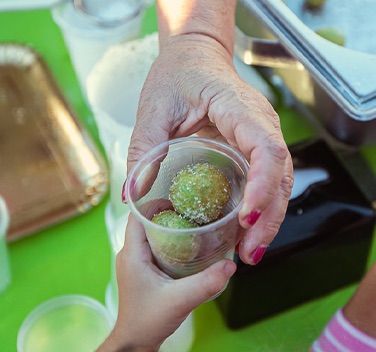
We invite you to discover authentic local products from the heart of Podgora — enjoy premium homemade olive oil, traditional delicacies, and the unique flavors of our coast. Learn more about local products, their stories, and how they are made, all while enjoying warm Dalmatian hospitality.

Batosevo Guvno/Guvno

Before the earthquake of 1962 and the relocation of the populace towards the shoreline, and before the advent of tourism the people would relax on the Guvno after a hard day's labour in the fields or on the sea and talk about the daily events. Depending on the size of the hamlet there would be one or two such places. The most important one for the whole of Podgora before the earthquake was Batosevo Guvno which consists of a small plateau with stone benches and a fountain in the centre.

Church and Cemetary of St. Tekla

The first mention of  St. Tekla dates from 1626 according  to a report from the bishop of Makarska to the holy seat. Building of the church is connected to the inhabitants of the hamlet of  Vrulja. The church existed before the cemetary was moved due to the earthquake of 1667 to point Sutikla. It is assumed that it caused as much damage as the earthquake of 1962. The baroque church of  St. Tekla has been completely renovated. Before the renovation extensive archeological excavations proved the existence of graves dating from  the Middle Ages. The gravestones date from XIV and XV century and it is presumed they were transferred at the beginning of the XVIII century from the cemetary of the Church of All Saints.

Four tablets  retain the outline of a shield under which a sword is visible. On the 5th tablet only a shield is visible. They are heraldic motifs most likely depicting the graves of lower members of the village clan and perhaps in some cases more prominent members. Next to the church and the graves, as a cultural heritage, can be found a monument to Don Mihovil Pavlinovic. The monument is the work of the Croatian sculptor Ivan Rendic, unveiled on the 17th May, 1908, the 20th anniversary of the death of the Podgoran great.

 It is located in the south side of the cemetary. On the front of the monument a bronze relief  dominates the chest of Pavlinovic, with a cross made in mosaic and writings in Glagolic with translations on the back of the monument.

Don Mihovil  Pavlinovic  (Podgora 28th January, 1831 - Podgora 18th May, 1887) was a priest, a politician and a writer. One of the founders and the leader of the People's Party and the Croatian revival in Dalmatia, his whole life was dedicated to encouraging the unification of Dalmatia with the rest of Croatia.

He was a representative in the Croatian and Dalmatian parliament and was the first to give a maiden speech in the Croatian language in the Dalmatian parliament. Following that it became acceptable to speak Croatian in the Dalmatian parliament. He was also the editor of the the People's Voice newspaper (Il Nazionale).

He toured Dalmatia stirring the national conscience and encouraging a greater interest in education in an attempt to get the villages out of their economic malaise. With his energy and charismatic Influence on the people he is amongst one of the most important leaders of Croatian politics in Dalamatia in the 2nd half of he 19th century.

The name of Sutikla cannot be proved with any certainty, but the point itself is an important navigational marker for shipping traffic along the coast.

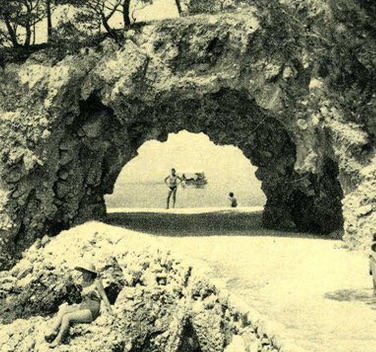
The appearance of the cemetary has changed in the 20th century especially since the retaining wall was damaged due to the construction of new graves. After the earthquake of 1962 the whole appearance of the point has changed especially after the collapse of the "arch of happiness".


Church of St. George XIX century

It is assumed that the origin of the church dates from the 19th century. According to sayings the church was built by local parishioners from the hamlet of Suskovi. Some historical evidence mentions the church of

St. Jurja as a private church however the names of he owners are unknown.

The church was renovated in the 1990's.

Church of St. Roka XVII century

The first mention of the the Church of Saint Roka  dates from 1672. according to sayings the area in front of the church is a cemetery dedicated to victims of the Black Plague. An interesting note from history is that during the First World War the missing bell from the church was melted down and used by the opposing army as cannon balls. In the past the Church was used to celebrate holy mass on St. Roko's day this lasted until the 1950's. After the earthquake of 1962 due to neglect and the lack of conservatorial interest the church was left in ruins.


Church of All Saints XVIII Century

There are indications from the stones of the first church of All Saints which was completely destroyed in the earthquake of 1667, that a new church of All Saints was built. Building commenced in 1668. after Turkish attacks the church suffered relatively major damage, so on the same site and on the same title of 1764 a new baroque Church of All Saints with campanile was built again and remains to this day.

The baroque Church of All Saints is a simple building with a large semicircular apse, consisting of seven alters of which five are completely marble. From the time it was first built until the earthquake of 1962 the Church of All Saints was the spiritual centre of Podgora. The church was restored in 1975. Today all holy masses take place on the first Sunday of the month and for more significant days especially for St Vincent the patron saint of Podgora. Bones of St Vincent with a small cup of his dried blood were exhumed from the old Christian grave of St. Cirijaka and given as a gift to the canon of Makarska and vicar Ivan Josip Pavlovic from pope Pious VI. in 1790.

After his death his brother canon Don Grgur Pavlovic on 22nd January, 1830 donated the bones to his colleague Don Lovre Pavlinovic. After permission was given by the authorities in August, 1831 the second alter on the right hand side of the entrance to the church was dedicated to St. Vincent and at the same time it became his last resting place. In Podgora respect for his sacrifices very quickly took hold and shortly on

St Vincent's day, the first Sunday after the holy day of Velika Gospe pilgrims from the regions of Dalmatia and Hercegovina began to arrive.

Nothing much is known of the saint's life other than he was a Roman soldier who would rather sacrifice his life than betray his conscience, character and loyalty to Christ the Saviour. From 1900 bishop Nakic declared that in future "Reverence" for St. Vincent was to last three days and the tradition remains to this day. Today the Church of All Saints is culturally and historically the most important church in Podgora, and one of the most monumental baroque churches in Dalmatia.

Church of St Liberana XVIII Century

The church of  St. Liberana was most probably built in the XVIII century, on the grounds of the Church of All Saints or a few metres east. The church received  its name from  St. Liberana or Liboriu a long serving Gallic bishop. This title is very rare in our region and can be found only in southern Dalmatia.  

Up until the 1960's the holy mass of  St. Liberana  was celebrated in this church.

The tradition of celebrating mass ceased after the earthquake of 1962, when the church was extensively damaged. The 1991 archeological excavations confirm the existence of older structures both beneath and beside St. Liberana. ie: remnants from the first church of All Saints from XVIIIc. in front of the alter of the church of St. Liberana can be found a headstone oriented towards the South East.

Church of St. Carman XIX century

The church was built as a parish church in 1878  during the earthquake of 1962 the church suffered some damage which has now been rectified. Before 1962 apart from the normal masses, the church was used for funeral rites for the inhabitants of the hamlets of Vruja-Milicici. Meanwhile after the earthquake most inhabitants left  to pursue a new life in the inlet of  Caklje inspired by the advent of tourism and the church lost its function. Today mass is celebrated only on  St. Carmela's day.

Church of Uznesenja Marijina XX century

The foundation stone of the church was laid on 2nd May, 1963 and it was finished and consecrated the following year. It is a modern building based on the shape of a tent, designed by the engineer Ante Rozic. An interesting fact regarding this building is that the designer specified that the building was to retain its natural cement colour, giving the impression to some people that it is still unfinished. The reason given for building a new church was because most inhabitants by that time had moved closer to the coast.


Church of the Holy Cross XIX century

The Church of St. Kriza (The Cross) or as the locals call it the church of the Holy Christ dates from

the 19th century. According to sayings it is assumed at the church was built by the Radonic family.

During renovations in 1907 the church functioned as the parish church.

Changes were made to the front of the church during the renovation of 1990, however, they were not finished and the church is no longer used for masses.


Church of the Sacred Heart XIX century

This is a late baroque church of 1804. The church was built within the confines of the Mrkusic family as a private place of worship. Within the confines there existed a private hotel Villa Ana, which after the 2nd  World War was nationalised and renamed hotel Podgorka. During the demolition of the old hotel and the building of the new hotel the gardens belonging to the Mrkusic family were mostly ruined.

The church suffered minor damage during the earthquake of 1962 compared to other churches in the area. As a result for some time after the earthquake he church was used as the parish church until a new one was built. Today masses are held on Sacred Heart day and every Sunday afternoon.


Lighthouse and Chapel

Sometime ago the lighthouse was connected to the shoreline by a small bridge. Later on it became a small islet a few metres from the shoreline. Due to reconstruction of the shoreline the lighthouse was restored and relocated. It served two functions. Firstly as a guide for fishermen and sailors, and secondly as a chapel which was dedicated to the blessed Virgin Mary and St. Nicholas protector of sailors and travellers. On top of the structure was a light and on the seaward side there were two recesses which contained two bronze reliefs of the Virgin Mary with child and St. Nicholas. Both works are by sculptor Zlatko Cular.

The structure is no longer in use as a lighthouse and even the oldest inhabitants of Podgora have no memory of when it was built.

Some literature contends it is amongst one of the oldest existing lighthouses in the Mediterranean.

Monument to the fallen warriors of the 2nd world war

The monument was built in honour of the fallen soldiers of WWII as well as the victims of fascist terror. Designed by the sculptor Ivan Mirkovic and built through local donations and voluntary workers.

The monument has a concrete base and is lined in white stone. On both sides there are two stone tablets etched with names of the fallen. On the top is a two metre high statue depicting a Biokovo partisan with a gun in his hand protecting a wounded soldier.             

Roščića Tower

The majority of military defence posts on the Makarskan Litoral and in Podgora were built during the Turkish occupation in the XVI and XVII centuries. There are three types of known defence posts: castles, towers and forts. Towers were usually built near the entrance of a village especially on the path leading up to it. In the XVII century every hamlet in Podgora had two towers which signifies their importance at that time. Even the name of Podgora is connected to the Latin word castellum meaning refuge, castle or tower.

The Roscic tower can be found East of the path which connects the main road over Staza to the centre of the village. During the earthquake of 1962 the Roscic tower was damaged and today it remains in a relatively poor condition. The tower itself is square in shape with the North and west walls preserved up to the height of the first floor, while the South East corner is in ruins. On the north wall of the first floor there are still visible gun placements.

Seagull's Wings Monument

"Stop and listen living legend of freedom, the sea whispers below the rocks of  Biokovo, sea tireless sea, deep sea...."

                                                               June Kastelan


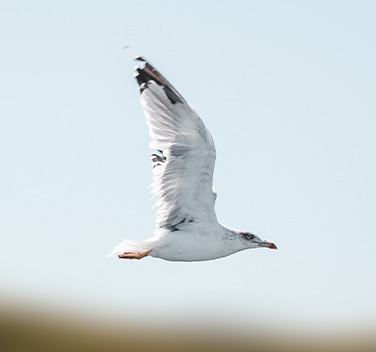
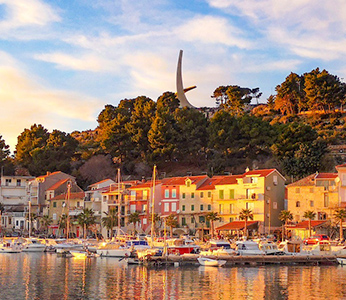
The monument's name is a symbol of the Adriatic Sea, Dalmatia and a tireless seagull. The vertical wing symbolises victory, while the broken wing symbolises the fallen marines in their fight for freedom. Through an open tender the present structure was chosen and building commenced in the 1960's. The sculptor is Rajko Radovic. Built sixty metres above sea level, the foundations of the monument are laid 12 metres below the earth. There is a plateau on the front of the monument which has a bronze relief depicting various sea battles. It is built of white cement and reaches a height of thirty three metres. It is one of the tallest monuments in the Republic of Croatia. Behind the plateau and in the vicinity of the monument there is a large ampitheatre seating eight hundred people which was commenced in the 1960's with the second stage completed in 1984.

Smokvica Water Source-Centre of the Village

Smokvica is one of the sources of water in Podgora. An interesting fact is that there are seventy seven water sources while some literature mentions an even bigger number. During the summer some sources tend to dry out. The sources are grouped in two areas mainly from Grebica towards the shoreline and on the other side from Bistrica towards the shoreline. Water from these sources is clear, cold and of good drinking quality. The temperature of the water does not exceed eleven degrees during the summer months.


The Monument to Lady Biokovka in Drašnice

The Monument to Lady Biokovka in Drašnice is a mosaic by the painter and sculptor Joke Knežević from 1974. It is one of his two memorial mosaics dedicated to women of NOB (Narodnooslobodilački Pokret - National Liberation Movement). Using Goya's Third of May 1808 as inspiration, Knežević told the story of Berta Alač whom the Italian occupators shot because of her involvement with the Partisans. Berta, who in this piece represents all Biokovke women that showed resistance to the occupator, is unfolding her thin short coat in front of the firing squad. The heroic gesture is accompanied by moping villagers dressed in folk garments, while burning houses are seen in the distance. Next to Berta, a washbowl and a towel are shown, which she, according to witnesses, used before her shooting to wipe the blood off the wounds she got when she was tortured.

The church of St. George in Drašnice

The church of St. George (Croatian Sv. Juraj), close to the sea, was most probably built at the beginning of the 15th century. The name Drašnice and the name of the church were first mentioned in Turkish documents from 1477 and 1523 respectively. Unfortunately, many wars, destructions and earthquakes in the past 600 years have damaged it quite a lot. But there were also restoration rebuilds at the beginning of the 17th century. After the 1962 earthquake destroyed the church, a new one was rebuilt at the same location and was sanctified in 1976.

Three Mounds

The name represents four standing stone burial mounds. The stone mounds or (tumul) are situated three metres apart. The first and second mounds are of a similar size. The first mound is slightly strewn about on the South and north east side as well as the top. While the second mound is mostly strewn about  on the south east side as well as the top. The third mound has been recently excavated and is in poor condition compared to the first and second. The fourth mound or (tumul) has been totally excavated and there is evidence of historical graves in the centre. Mounds or (tumuls) represent typical stone structures from Illyrian times and were usually placed in elevated positions signifying the graves of people of note, and at the same time were used as look-outs.


Water source - Kržanići

The source of water in Kržanići is one of the many public water fountains in Podgora. The fountain was originally built in 1898 and restored in 2015. Interestingly, there is often mention of 77 springs in Podgora, but some literature mentions a greater number of springs. A certain number of springs dry up in the summer. The springs are grouped into two areas: in the wider area from Grebica towards the coast and in the wider area from Bristica towards the coast. The water from the springs is clear, cold, and of excellent quality for drinking. The water temperature in the summer months in the broader areas of Grebica and Bristica does not exceed 11°C.


You have time to look around

Getting Around

See sights and attractions in other places by filtering the distance from Podgora and Drašnice.

Read More
Need help?

Contact Us

Phone Podgora
+385 21 678 942
Phone Drašnice
+385 21 625 560
Working hours
Mon - Sat: 7:30 - 20:00
Sun: 7:30 - 13:00
Office location
Google map

You are looking for more information or you want to contact us via the inquiry form.

Read More